Around the world and throughout history, from today’s street markets in Thailand and Italy to historical food markets in ancient Rome and China, the open air and travel on foot have always been associated with culinary big ideas. London is no stranger to this, with various culinary oddities offered on the capital’s streets through the centuries - including watercress sellers who would sell bundles of salad to people in Covent Garden in the 19th century. Today, the wider pedestrianisation of central London is sparking the imaginations of culinary creators once again - and nowhere more so than the historic pedestrianised dining destination Sicilian Avenue, reopening this year.
What is Sicilian Avenue?
The iconic street, which has played host to walkers and diners for 116 years, has seen three venues open in recent years - with Flying Horse Coffee opening its first London location on the street, and even matching its coffee machine to the Grade II listed oriel windows. For others such as mindful Japanese tea house MATCHADO, the setting formed an inspiration for the bakery creations to be found within. Founder Hiromi Matsunobu says, “It’s wonderful to open MATCHADO in such a heritage-rich location just minutes away from The British Museum. The calm, heritage surroundings on Sicilian Avenue are the perfect setting to experience the thoughtful, mindful nature of Japanese tea culture.”
When is Sicilian Avenue reopening?
The wider reinvention of the area is sparking culinary imaginations, and in turn, helping to drive a wider reinvention of central London. Alexander Jan, Chair of the Central District Alliance BID said, "This remarkable part of the Bloomsbury/Holborn area has always been much loved by residents, workers and students, and will now provide a pleasant experience for tourists, particularly the dining experience it is curating – which is great for business.”
Is Sicilian Avenue a Pedestrianised Street?
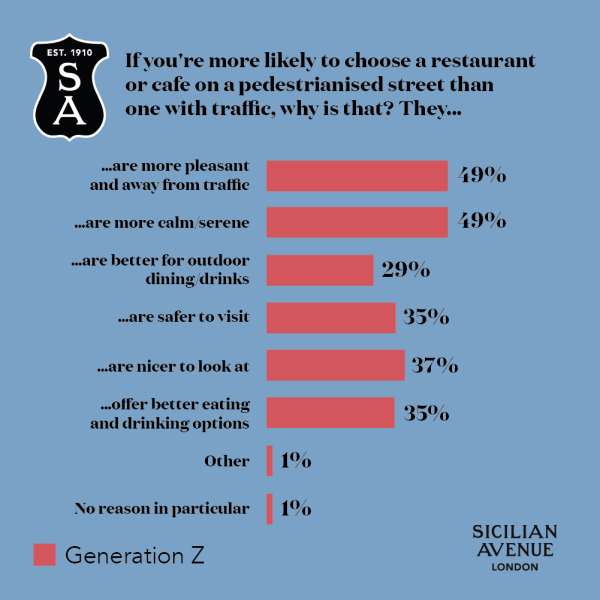 Sicilian Avenue Graph - If you’re more likely to choose a restaurant or cafe on a pedestrianised street than one with traffic, why is that? Generation Z
For young people, pedestrianised streets seem to be inextricably bound to better dining experiences, with over a third (35%) saying that they offer better dining options, and 29% opting for pedestrianised streets in order to enjoy drinks and food outdoors, according to research by Sicilian Avenue. With wider experiments in the Oxford Street area finding that a ‘traffic free’ day raised the number of visitors by 50%, pedestrianisation clearly offers a measurable boost. Research by HospitalityGEM found that pedestrianised streets increased dwell time for diners in restaurants by 79%, supporting Sicilian Avenue’s findings where 88% said they’d visit for a drinking and dining experience.