People on foot are more likely to stop, decide they fancy a nibble to eat, or just look around a shop, and act on that impulse. People in cars just glide past - and even if they did think about stopping, they’d immediately worry about where they could park. Statistics show just how much pedestrianised streets can boost business performance: in New York, pedestrian improvements at one junction boosted local retail sales by 48%, according to Living Streets’ latest annual ‘Pedestrian Pound’ report, which showcases similar boosts in Britain and around the world.
The researchers write, “There is strong evidence that pedestrians and cyclists spend more than people arriving by motorised transport. Several international studies have compared the differences. In a 2009 study of the Bloor Street area in Toronto, people who biked and walked there reported they spent more money there per month than those who arrived by car.”
Sicilian Avenue Redeveloped for Foodies and Serenity Seekers
The idea that shopping on foot might tempt shoppers to spend has a long history, dating back to the dawn of the motor car itself. London’s Sicilian Avenue, built in 1910, just as motor cars became the default mode of transport in London, was built on a vision of car-free streets, and its quirky row of classical columns beckoned passers-by into a tranquil space where they could enjoy bookshops and other delights.
Research by Transport for London (TfL) into the benefits of pedestrian-friendly streets was even more conclusive, and highlighted that it's not simply that people on foot are more likely to go into shops. The research found that walking and cycling improvements can increase retail sales by up to 30%, and that people on foot make an average 16 visits to their local town centre each month, compared to eight for people in cars. Most interestingly of all, though, people who walk to their local high street spend up to 40% more.
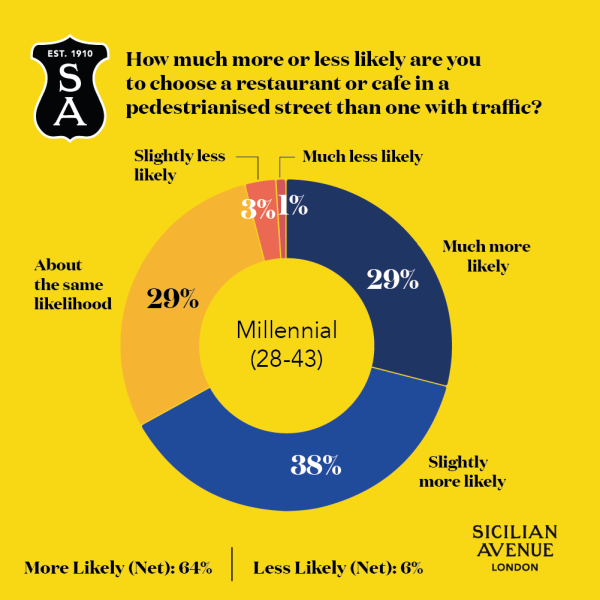 Sicilian Avenue Graph - How much more or less likely are you to choose a restaurant or cafe in a pedestrianised street than with traffic? Millennials
Sicilian Avenue Unites People of All Ages
Attitudes to pedestrianisation vary by generation: research this year by Sicilian Avenue 49% of Baby Boomers say they are likely or much more likely to choose a pedestrianised street for a restaurant or cafe, while among Millenials, 67% are likely or much more likely to choose a pedestrianised street for the same purpose. But with only tiny minorities saying they are less likely, it's clear that pedestrianised spaces have a powerful allure for people seeking to dine - and to spend.
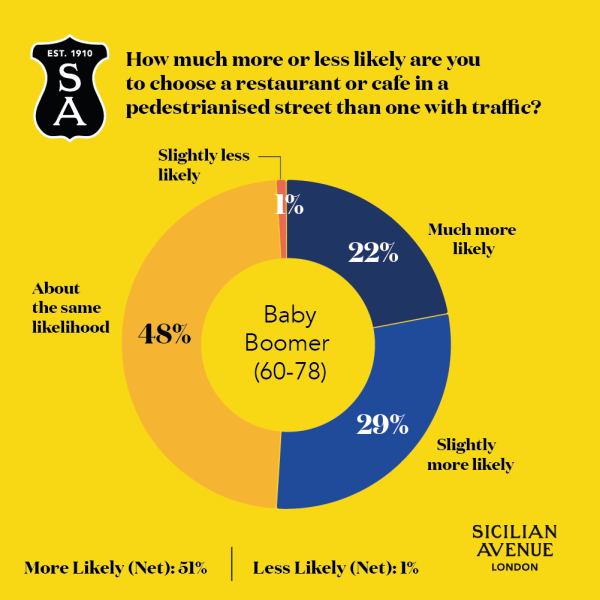 Sicilian Avenue Graph - How much more or less likely are you to choose a restaurant or cafe in a pedestrianised street than with traffic? Boomers